A fractional product designer is a senior designer who works with your team part-time and for the long run, instead of being hired for one task. Sellers print $3,000 to $10,000 a month for one to three days a week. It fits a startup that needs design every week but cannot fill a full-time seat. I'm Milan, and I work this way.
The word is used loosely, so what follows is how I use it. The prices are what other people print, each with a link. The month I describe is a real one from my own work, with the company left out.
What is a fractional product designer?
A product designer designs the thing people use: the screens, the flows and the system of parts they are built from. Fractional means you get part of their week, not all of it. You send requests, and they come back designed and, in my case, built.
Here is where I draw the line. A freelancer is someone you call when you need quick help with a task. A fractional designer is a freelancer who stays. They help build the whole thing, and they go beyond a single task because they know where the product is heading.
Fractional designer vs freelancer vs agency
An agency has several people attached to it. You hire all of them, and you are not always in direct contact with the person you actually want. There is a middleman between you and the designer.
- Agency: best when you need a whole team for one large project, and can carry the overhead of the people between you and the work.
- Freelancer: best for a task with a clear end, like a landing page or a pitch deck.
- Fractional: best when design never stops, because the product keeps changing. You talk to the person who does the work, and they remember what happened last month.
What does a fractional product designer cost?
It depends on the days per week, the seniority and what is included. Every price I found comes from someone who sells the service, so read them as asking prices. Call The Design Guy puts it at $3,000 to $10,000 a month for one to three days a week, roughly 8 to 24 hours, and says most engagements start with a three month commitment. Konigi charges $14,000 a month for two or three days a week, with the front-end code included. Digital Design Studio lists $6,500 a month for one project and $9,000 for two to four, also with code.
| What | Price | From |
|---|---|---|
| Full-time senior designer, first year | $200,000+ | Call The Design Guy |
| Fractional, 1 to 3 days a week | $3,000 to $10,000 a month | Call The Design Guy |
| Fractional design and code, 2 to 3 days | $14,000 a month | Konigi |
| Fixed project, website to website and app | €6,450 to €19,850 | Me |
The gap between them is mostly days. The lowest figures are for one day a week, and the highest are for two or three days with the code included. Compare like with like before you compare prices.
Fractional designer vs hiring full-time
The usual comparison sets a monthly retainer against a salary, which is unfair to both. Compare it with what an employee costs all in. Call The Design Guy puts a senior designer's base pay at $140,000 to $180,000 at a funded startup, and the real first-year cost above $200,000. Digital Design Studio uses a base of about $180,000 and adds 20 to 30% for benefits and payroll taxes, which brings it to $216,000 to $234,000.
The US Bureau of Labor Statistics has a neutral number for that on-cost. In June 2026, benefits such as insurance, paid leave, retirement and payroll taxes were 30.0% of what private employers paid per hour worked, $14.07 of $46.89. For every $100 of wages, that is about $43 on top. Salaries vary a lot with seniority: the same agency's median for web developers and digital designers was $99,520 in May 2025.
The logic runs the other way too. A freelancer or fractional designer pays for everything an employer would cover: software subscriptions, insurance, taxes and unpaid days. All of that sits inside the rate. So a monthly fee that looks big next to a salary is not the same kind of number. Put it next to the all-in cost of an employee.
Konigi gives a fair test for when to go full-time: when the design work is large enough to fill a week. Below that, part of a senior person usually beats all of a junior one.
A real month: what I shipped in 30 days
Here is one retainer month from my own work. I leave the company's name out. In that month I made the following for them.
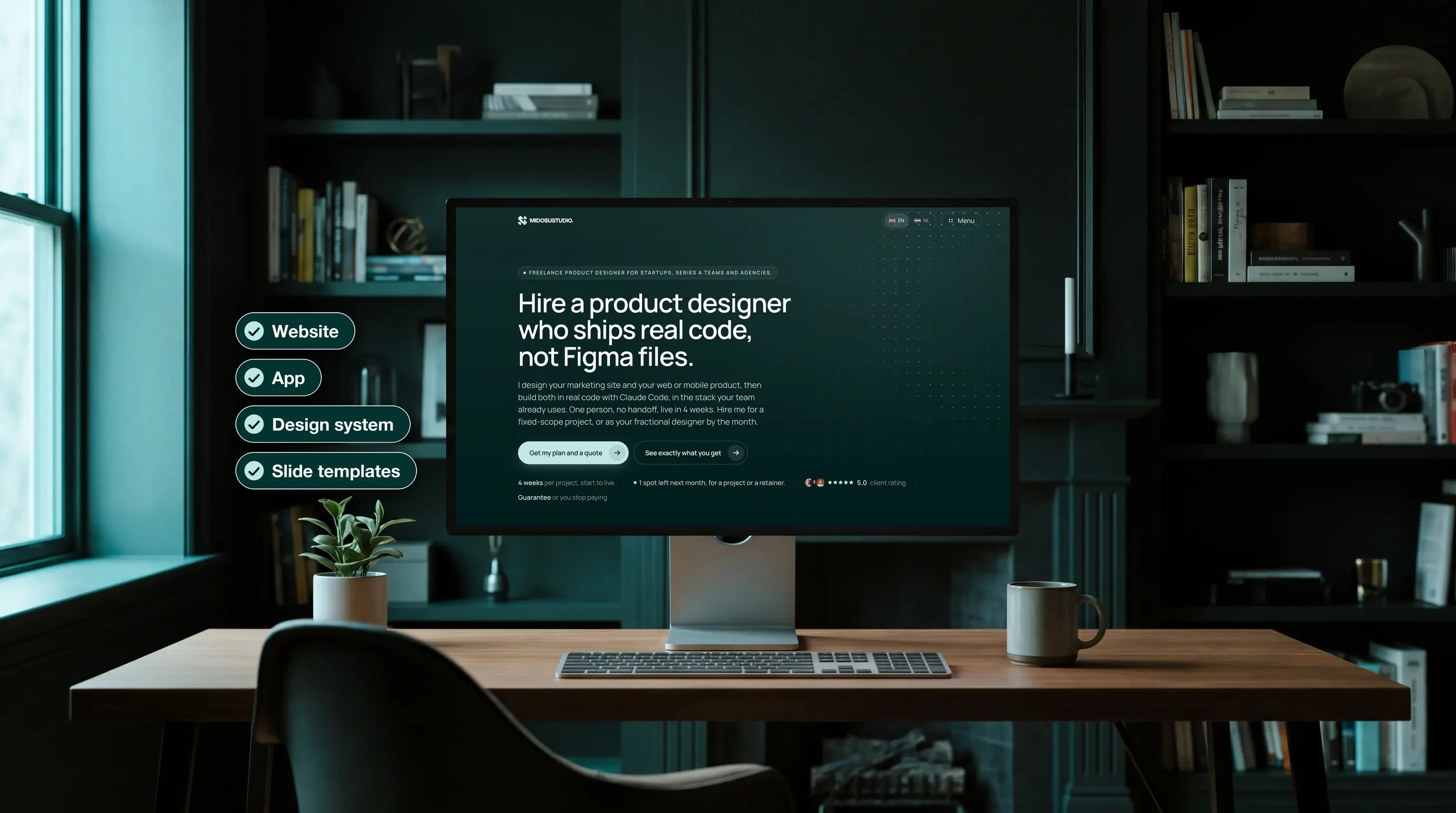
- A new marketing website: built to turn more of its visitors into conversations.
- The web application: several rounds of design on how it works and how it looks.
- A design system: the whole thing, so every new screen starts from the same parts.
- Branded slide templates: a bonus, so the team can make new presentations with Claude in the company's own style.
All of it pointed at one goal: getting the company ready to raise more money. The website had to convert more visitors. The app had to look more high end and get users to what they came for sooner.
A designer who also codes: what changes
Most designers hand a file to a developer, and something gets lost on the way. I build the front end myself, in real code, with Claude Code. What I design is what ships, so there is no handoff to lose it in.
The limit is that I do the front end. If your product needs a backend, a database or an API, your engineers or someone else builds that, and I work with them.
Who should not hire a fractional designer
Skip it if you want to lowball the price and then doubt the design choices. You hire a designer for their judgment. If you do not trust it, you pay for it and overrule it, and the work gets slower and worse.
Hire full-time instead if the design work fills a whole week, or if it is so tied to your domain that a part-time person never builds up the context. Konigi says the same. And if you only need one thing done, hire a freelancer, because fractional pays off over months, not for a single task.
What you keep when it ends
You keep the entire design system and a solid base for building more, so your team can make new screens much faster than before. You also keep working products. Nothing is locked to me. You can hire someone, use your own team or keep me on.
What I charge
My fee for a fixed project is €6,450 for a marketing website only, and up to €19,850 for the website and the front-end designs of your product. Prices in this article are in US dollars as the sources print them, except mine, which are in euros.
That is one person, so there is no account manager or project manager to pay for. A retainer is priced separately, so ask me for that number. Set my range against the figures above: more than $200,000 for a senior employee in the first year, and for an agency, Clio Websites puts a marketing website at $3,000 to $50,000 or more. My cost guide goes through what drives that number.
Questions people ask
How many hours a week does a fractional designer work?
Sellers say one to three days a week, which Call The Design Guy counts as 8 to 24 hours. I do not sell hours. You send requests, and I design and build them one at a time, in the order you choose.
Is a fractional designer the same as a freelancer?
No. A freelancer takes a task and leaves. A fractional designer stays for months and helps build the whole product.
How long is the minimum commitment?
It depends on the seller. Konigi asks for three months, then goes month to month. Digital Design Studio offers a monthly plan with no minimum and a quarterly one with a three month minimum. My retainer runs month to month, and if you cancel in the first 30 days I refund that month.
What happens when the engagement ends?
You keep everything: the design system, the code and the working products. Your team can carry on without me.
Is it cheaper than hiring full-time?
Usually, if you compare it with the all-in cost of an employee. But at Konigi's price, two or three days a week at $14,000 a month comes to $168,000 a year, close to a senior employee's first year. The saving shrinks as the days go up.
How do I start?
Tell me what you are building and what you need next on the contact page. I tell you honestly on the first reply whether it fits.
I wrote this from my own answers with help from Claude, and checked every outside number against the page it links to. The scene in the header was made with Higgsfield, and the screen on the monitor is my own site. Prices as of November 2026.